A Compendium of the Ancient Gods
Awaiting its plate

Lemminkäinen was the warrior-hero of the Kalevala, third of its central trio after Väinämöinen the sage and Ilmarinen the smith, and quite different from them in character: where they were old, deliberate, and patient, Lemminkäinen was young, reckless, vain, prone to amorous adventures and ill-judged escapades. His mother — the principal female figure of his cycle — was the great anxious caretaker who repeatedly worried over her son's safety and repeatedly proved correct in her worry.

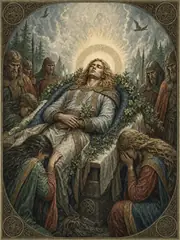
His central narrative is his death and resurrection. Sent on an impossible quest to Pohjola (to shoot the swan of Tuonela, the river of the dead), he was killed by a poisoned dart from the blind shepherd of Pohjola, his body cut into pieces and thrown into the river of Tuonela. His mother, sensing his death (a hairbrush of his that she had kept began to bleed, the agreed-upon sign), came searching for him; she went to the smith Ilmarinen, who forged her a great copper rake; she dragged the river of Tuonela with the rake and drew up her son's pieces, one by one. She then sang the great resurrection-charm, calling upon the Bee to fetch her honey from the gods' country, and with the divine honey she pieced her son back together and returned his soul to him. He returned to life — chastened, but not enough to learn lasting prudence; his subsequent adventures continued in much the same heedless mode.

The mother-of-Lemminkäinen episode is the most famous of the Kalevala's emotional moments; the image of the mother gathering her son's pieces from the river has had an extensive modern artistic reception (Akseli Gallen-Kallela's painting Lemminkäisen äiti, "Lemminkäinen's Mother," 1897, is the iconic Finnish national-artistic treatment, hanging in the Ateneum in Helsinki).
Curator’s note

What the sources say, and what later tradition added. The sources for this bay

The principal source is the Kalevala, Cantos 14–15. Gallen-Kallela's painting and Sibelius's tone-poem cycle Lemminkäinen Suite, Op. 22 (1895), are the principal modern artistic receptions. The death-and-resurrection motif has parallels (Osiris in Volume II, Baldr in this volume's Norse book, the Greek Adonis) and reflects an underlying mythological pattern of considerable antiquity.

Kin in the sources

Each tie is quoted from the entry that states it.

When the sources speak

Dated witnesses for The Finnic, Hungarian and Albanian Traditions. A date marks when the evidence was written down, not when the belief began. The whole timeline

2nd–1st millennia BCE
Indo-European language dispersals and regional Bronze Age cultures provide a remote comparative background, not a recoverable common canon.
c. 500 BCE–1 CE
Iron Age material culture, names, sanctuaries, and classical ethnography offer early but external evidence for Celtic and Germanic religions.
1st–4th centuries CE
Roman inscriptions and provincial cults preserve many Celtic, Germanic, and local divine names.
4th–8th centuries CE
Migration-period and early medieval conversion transform ritual institutions while heroic traditions continue.
8th–11th centuries CE
Viking Age poetry, runic evidence, archaeology, and Scandinavian conversion form the core context of Norse myth.
9th–12th centuries CE
Slavic, Baltic, and Finnic traditions enter chronicles and missionary accounts, often through hostile observers.
11th–14th centuries CE
Irish, Welsh, and Icelandic manuscripts preserve major narrative corpora in Christian literary environments.
12th–16th centuries CE
Saxo, saga compilers, Baltic chroniclers, and later antiquarians systematize or reinterpret older material.

Floor plan

The rooms follow one another in the order their peoples first appear in the written record.

  1. The Cradle of Citiesc. 3400 BCE to 395 CE. 115 works
  2. The Gift of the Nilec. 4000 BCE to 395 CE. 73 works
  3. The Olympian Orderc. 1600 BCE to 750 CE. 152 works
  4. The Persian Worldc. 2000 BCE to 1010 CE. 30 works
  5. The Levantine Borderlandsc. 1200 BCE to 500 CE. 20 works
  6. The Edges of Empirec. 2000 BCE to 1500 CE. 33 works
  7. The Etruscan Worldc. 900 BCE to 750 CE. 22 works
  8. The Roman Inheritancec. 1200 BCE to 500 CE. 58 works
  9. The Northern Inheritancec. 2000 BCE to 1600 CE. 131 works