A Compendium of the Ancient Gods
Awaiting its plate

We turn from Finnic to the closely related Magyar tradition. The Magyars came to the Hungarian plain in the late 9th century from the steppes east of the Volga, where they had lived in close contact with various Turkic and Iranian peoples and where their religion had taken on the broadly Eurasian-shamanic character common to the steppe peoples of that period. Their conversion to Christianity, accomplished under Saint Stephen I about the year 1000, was thoroughgoing; the pre-Christian Hungarian religion was more fully effaced than perhaps any other European pagan tradition, with very little of its detail surviving the conversion.

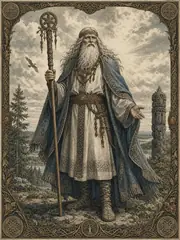
Isten was the Magyar pre-Christian sky-god — the high god of the heavens, presumably parallel to the various Turkic and Mongolian Tengri-figures (the Eurasian-steppe sky-god whose cult was widespread among the peoples of the Magyars' pre-migration neighborhood). The original Magyar Isten is largely unrecoverable; we know he existed (the modern Hungarian word for "God," Isten, preserves the name, just as Lithuanian Dievas preserved its pre-Christian sky-god's name through the conversion), but the developed theology and mythology that surrounded him in pre-Christian Magyar religion were not preserved in the Christian texts of medieval Hungary. The name's etymology has been variously proposed: a connection to Iranian *Iśtana (a borrowing from the Magyars' Iranian-influenced steppe-period); a native Uralic etymology; a substrate borrowing from earlier Carpathian-basin populations. None of these is securely established. What can be said is that the Magyars' pre-Christian religion was of broadly Eurasian-shamanic-and-steppe-pastoralist character (as evidenced by the surviving táltos-tradition, the Magyar shamanic figure who survived in folk-belief into the early modern period and whose practices parallel those of Siberian and Central Asian shamans), with Isten as the high sky-god at the head of a pantheon whose other figures are largely lost to us.
Curator’s note

What the sources say, and what later tradition added. The sources for this bay

The principal sources are linguistic (the survival of Isten as the standard word for God) and the somewhat-later medieval Hungarian texts (the Gesta Hungarorum of Anonymus, c. 1200, and the Chronicle of Simon of Kéza, c. 1283, both written in Latin and giving stylized accounts of the Magyars' pre-conversion religion). The Eurasian-shamanic context is treated in Vilmos Diószegi, Tracing Shamans in Siberia (1968) and elsewhere; the táltos-survival is discussed by Mircea Eliade among others.

Kin in the sources

Each tie is quoted from the entry that states it.

When the sources speak

Dated witnesses for The Finnic, Hungarian and Albanian Traditions. A date marks when the evidence was written down, not when the belief began. The whole timeline

2nd–1st millennia BCE
Indo-European language dispersals and regional Bronze Age cultures provide a remote comparative background, not a recoverable common canon.
c. 500 BCE–1 CE
Iron Age material culture, names, sanctuaries, and classical ethnography offer early but external evidence for Celtic and Germanic religions.
1st–4th centuries CE
Roman inscriptions and provincial cults preserve many Celtic, Germanic, and local divine names.
4th–8th centuries CE
Migration-period and early medieval conversion transform ritual institutions while heroic traditions continue.
8th–11th centuries CE
Viking Age poetry, runic evidence, archaeology, and Scandinavian conversion form the core context of Norse myth.
9th–12th centuries CE
Slavic, Baltic, and Finnic traditions enter chronicles and missionary accounts, often through hostile observers.
11th–14th centuries CE
Irish, Welsh, and Icelandic manuscripts preserve major narrative corpora in Christian literary environments.
12th–16th centuries CE
Saxo, saga compilers, Baltic chroniclers, and later antiquarians systematize or reinterpret older material.

Floor plan

The rooms follow one another in the order their peoples first appear in the written record.

  1. The Cradle of Citiesc. 3400 BCE to 395 CE. 115 works
  2. The Gift of the Nilec. 4000 BCE to 395 CE. 73 works
  3. The Olympian Orderc. 1600 BCE to 750 CE. 152 works
  4. The Persian Worldc. 2000 BCE to 1010 CE. 30 works
  5. The Levantine Borderlandsc. 1200 BCE to 500 CE. 20 works
  6. The Edges of Empirec. 2000 BCE to 1500 CE. 33 works
  7. The Etruscan Worldc. 900 BCE to 750 CE. 22 works
  8. The Roman Inheritancec. 1200 BCE to 500 CE. 58 works
  9. The Northern Inheritancec. 2000 BCE to 1600 CE. 131 works