A Compendium of the Ancient Gods
Awaiting its plate

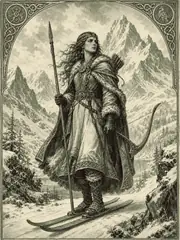
Louhi (also called Pohjan akka, "the old woman of the North") was the witch-queen of Pohjola, the dark land of the North in Finnic mythology — a place of cold, of magical danger, of monstrous offspring, and (paradoxically) of the Sampo, the great source of plenty that her own folk had somehow obtained. She was the principal antagonist of Väinämöinen and his companions throughout the Kalevala; she set them impossible tasks, demanded the Sampo's forging as a marriage-price for her daughter, fought them in great battles, and at last pursued them across the sea when they had stolen the Sampo, transforming herself into a great eagle to attack their ship. In the climactic battle, the Sampo was broken and lost in the sea; Louhi, defeated, returned to Pohjola with only its lid as her share, and Pohjola declined into the cold and barren place that Finnish tradition imagined it had been.

Her character was malign but not unmotivated; she was the queen of a land that needed the Sampo's plenty as much as Finland did, and her resistance to its theft was reasonable from her people's standpoint. The Kalevala, like much oral epic, gives the antagonist a coherent perspective even while siding with the protagonists. Louhi is one of the most fully developed female figures of Finnic mythology and has had a substantial modern reception in Finnish literary and cinematic tradition.
Curator’s note

What the sources say, and what later tradition added. The sources for this bay

The principal source is the Kalevala. The figure of the powerful witch-queen of the North has parallels in various Eurasian shamanic traditions and in the Norse Skadi (the giantess of the cold mountains, treated in Book I of the present volume); whether the parallels reflect borrowing across the Baltic-Finnic border or independent development is debated.

Kin in the sources

Each tie is quoted from the entry that states it.

When the sources speak

Dated witnesses for The Finnic, Hungarian and Albanian Traditions. A date marks when the evidence was written down, not when the belief began. The whole timeline

2nd–1st millennia BCE
Indo-European language dispersals and regional Bronze Age cultures provide a remote comparative background, not a recoverable common canon.
c. 500 BCE–1 CE
Iron Age material culture, names, sanctuaries, and classical ethnography offer early but external evidence for Celtic and Germanic religions.
1st–4th centuries CE
Roman inscriptions and provincial cults preserve many Celtic, Germanic, and local divine names.
4th–8th centuries CE
Migration-period and early medieval conversion transform ritual institutions while heroic traditions continue.
8th–11th centuries CE
Viking Age poetry, runic evidence, archaeology, and Scandinavian conversion form the core context of Norse myth.
9th–12th centuries CE
Slavic, Baltic, and Finnic traditions enter chronicles and missionary accounts, often through hostile observers.
11th–14th centuries CE
Irish, Welsh, and Icelandic manuscripts preserve major narrative corpora in Christian literary environments.
12th–16th centuries CE
Saxo, saga compilers, Baltic chroniclers, and later antiquarians systematize or reinterpret older material.

Floor plan

The rooms follow one another in the order their peoples first appear in the written record.

  1. The Cradle of Citiesc. 3400 BCE to 395 CE. 115 works
  2. The Gift of the Nilec. 4000 BCE to 395 CE. 73 works
  3. The Olympian Orderc. 1600 BCE to 750 CE. 152 works
  4. The Persian Worldc. 2000 BCE to 1010 CE. 30 works
  5. The Levantine Borderlandsc. 1200 BCE to 500 CE. 20 works
  6. The Edges of Empirec. 2000 BCE to 1500 CE. 33 works
  7. The Etruscan Worldc. 900 BCE to 750 CE. 22 works
  8. The Roman Inheritancec. 1200 BCE to 500 CE. 58 works
  9. The Northern Inheritancec. 2000 BCE to 1600 CE. 131 works