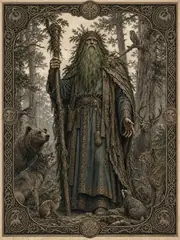
Tapio was the Finnic god of the forest — the master of the woodland, the giver of game to hunters, the protector of bears. His domain was Tapiola ("Tapio's place"), a magical forest-realm distinct from ordinary woods; hunters who entered the deep forest were entering Tapio's territory and had to observe his proprieties. He was bearded, dressed in moss and lichen, sometimes accompanied by his wife Mielikki (a kind goddess who made the woodland fruitful) and his daughter Tellervo. Hunters offered him small gifts (a coin in a hollow tree, a portion of the first kill) and recited charm-songs to win his favor.
His cult was strongly persistent in Finnish folk-tradition; the great composer Sibelius's tone-poem Tapiola (1926) is named for Tapio's realm and is a celebrated modern reception of the Finnic forest-spirit complex. The figure is parallel to the Slavic Leshy and the Germanic Wild Man; the broader pattern of forest-spirits attended Indo-European, Uralic, and other religious traditions across northern Eurasia.
When the sources speak
Dated witnesses for The Finnic, Hungarian and Albanian Traditions. A date marks when the evidence was written down, not when the belief began. The whole timeline
- 2nd–1st millennia BCE
- Indo-European language dispersals and regional Bronze Age cultures provide a remote comparative background, not a recoverable common canon.
- c. 500 BCE–1 CE
- Iron Age material culture, names, sanctuaries, and classical ethnography offer early but external evidence for Celtic and Germanic religions.
- 1st–4th centuries CE
- Roman inscriptions and provincial cults preserve many Celtic, Germanic, and local divine names.
- 4th–8th centuries CE
- Migration-period and early medieval conversion transform ritual institutions while heroic traditions continue.
- 8th–11th centuries CE
- Viking Age poetry, runic evidence, archaeology, and Scandinavian conversion form the core context of Norse myth.
- 9th–12th centuries CE
- Slavic, Baltic, and Finnic traditions enter chronicles and missionary accounts, often through hostile observers.
- 11th–14th centuries CE
- Irish, Welsh, and Icelandic manuscripts preserve major narrative corpora in Christian literary environments.
- 12th–16th centuries CE
- Saxo, saga compilers, Baltic chroniclers, and later antiquarians systematize or reinterpret older material.