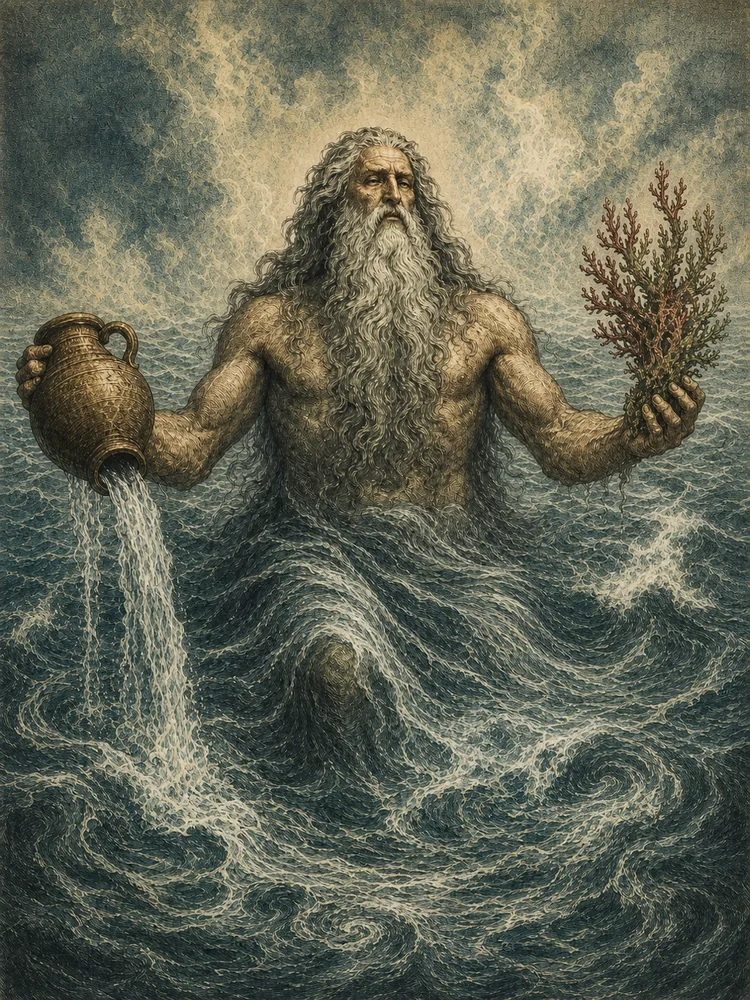
Hydros was Water, in the Orphic cosmogony given by Damascius — the primordial principle from which (in this account) all things proceeded, before even Chronos and Ananke arose. The doctrine that the world began from water has parallels in Thales's pre-Socratic philosophy (the world's first principle is water) and in the Mesopotamian cosmogonies (Apsu the freshwater abyss); whether the Orphic Hydros was independently developed or borrowed is debated. As a personified figure, Hydros had no cult and almost no narrative; he was a cosmogonic postulate of one school of Orphic theology.
 Before thisPhanes
 Next on the wallPhilotes
Curator’s note
What the sources say, and what later tradition added. The sources for this bay
The Orphic Hydros is principally attested in Damascius, De Principiis, paraphrasing earlier Orphic sources. The parallel with Thales (Aristotle, Metaphysics 1.3) and with Mesopotamian Apsu (Enuma Elish) has been remarked since the nineteenth century, but direct dependence is not securely demonstrable. Hydros's cosmogonic priority over Chronos and Ananke is a feature of one Orphic tradition; other Orphic theogonies place Chronos and Ananke first.
Kin in the sources
Each tie is quoted from the entry that states it.
 CreatedChronos
the primordial principle from which (in this account) all things proceeded, before even Chronos and Ananke arose
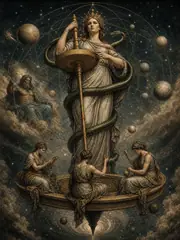 CreatedAnanke
the primordial principle from which (in this account) all things proceeded, before even Chronos and Ananke arose
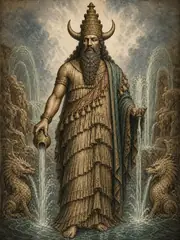 Compared withApsu
in the Mesopotamian cosmogonies (Apsu the freshwater abyss); whether the Orphic Hydros was independently developed or borrowed is debated
When the sources speak
Dated witnesses for The Primordial Powers. A date marks when the evidence was written down, not when the belief began. The whole timeline
- c. 1600–1100 BCE
- Mycenaean palace tablets in Linear B record offerings and divine names, but little continuous myth.
- c. 1100–800 BCE
- Post-palatial oral traditions and changing cult landscapes precede the surviving alphabetic epics.
- late 8th–7th centuries BCE
- The Iliad, Odyssey, Hesiodic Theogony and Works and Days give influential but non-exclusive divine orders.
- 7th–6th centuries BCE
- Homeric Hymns, lyric poetry, colonization, and local sanctuary traditions multiply regional narratives.
- 6th–5th centuries BCE
- Orphic, Pythagorean, and mystery materials develop alternative cosmogonies and afterlife doctrines.
- 5th century BCE
- Athenian tragedy and comedy recast heroic houses and divine justice for civic audiences.
- 4th century BCE
- Philosophers, antiquarians, and local historians interpret or criticize inherited myth.
- 323–31 BCE
- Hellenistic poets and scholars systematize variants across an enlarged Greek world.