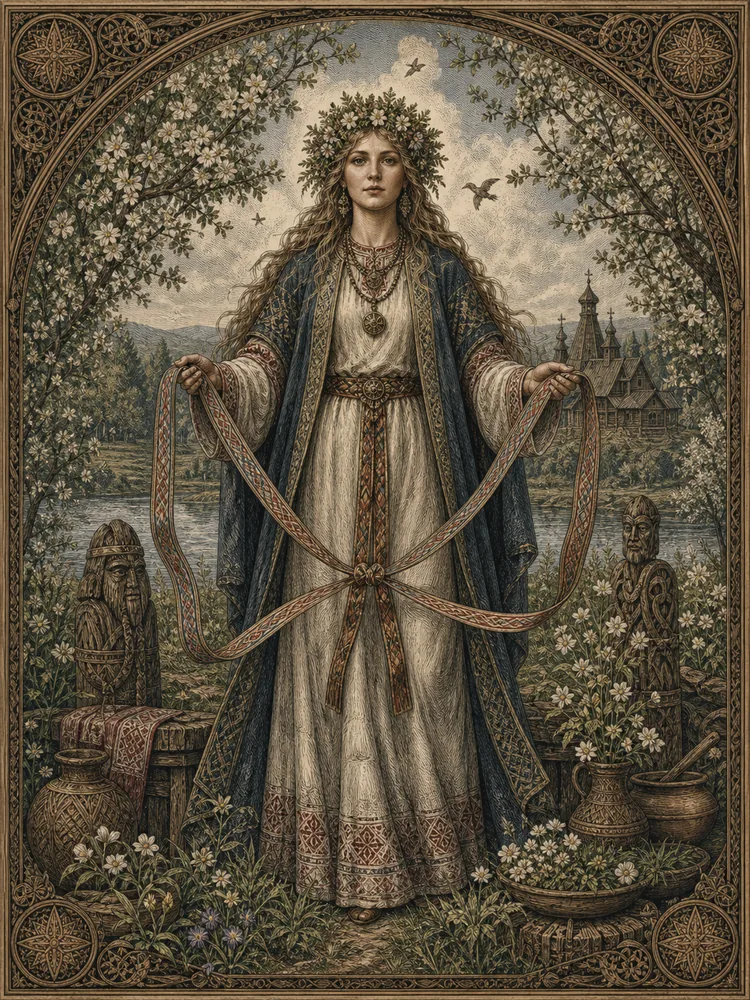
Lada was a Slavic goddess of spring, of fertility, of love and marriage, attested principally in Polish and Eastern Slavic folk-songs (where her name appears frequently as a refrain or invocation in spring and wedding songs) and in some medieval Polish Catholic sermons, where the priests fulminate against the people who continued to invoke "Lada, Lada" in their seasonal rituals. The figure has been controversial in modern Slavic-religion scholarship: some scholars accept her as a genuine Slavic goddess; others (notably the more skeptical Polish school) hold that "Lada" is merely a meaningless refrain-word in folk-song (similar to English "hey nonny nonny"), retroactively interpreted by Polish-Latin medieval writers as a goddess-name. The case is genuinely uncertain. Where Lada is treated as a goddess, she is taken to be the Slavic counterpart of the Indo-European spring-goddess (parallel to Lithuanian Lada/Laima — though the Lithuanian Laima has different functions).
 Before thisMokosh
 Next on the wallMorana
Curator’s note
What the sources say, and what later tradition added. The sources for this bay
The medieval Polish sources are the Statuta provincialia of Mikołaj Trąba (1420) and a sermon of c. 1410. Modern scholarship is divided; the skeptical view is in Aleksander Brückner, Mitologia słowiańska (1918), and has had considerable subsequent influence; the more affirmative view is in Marija Gimbutas's work and elsewhere. The Polish folk-refrain "oj lado lado" is genuine; whether it preserves a goddess-name or is a meaningless filler is the disputed question.
Kin in the sources
Each tie is quoted from the entry that states it.
 Compared withLaima
parallel to Lithuanian Lada/Laima — though the Lithuanian Laima has different functions
When the sources speak
Dated witnesses for The Slavic Gods and Spirits. A date marks when the evidence was written down, not when the belief began. The whole timeline
- 2nd–1st millennia BCE
- Indo-European language dispersals and regional Bronze Age cultures provide a remote comparative background, not a recoverable common canon.
- c. 500 BCE–1 CE
- Iron Age material culture, names, sanctuaries, and classical ethnography offer early but external evidence for Celtic and Germanic religions.
- 1st–4th centuries CE
- Roman inscriptions and provincial cults preserve many Celtic, Germanic, and local divine names.
- 4th–8th centuries CE
- Migration-period and early medieval conversion transform ritual institutions while heroic traditions continue.
- 8th–11th centuries CE
- Viking Age poetry, runic evidence, archaeology, and Scandinavian conversion form the core context of Norse myth.
- 9th–12th centuries CE
- Slavic, Baltic, and Finnic traditions enter chronicles and missionary accounts, often through hostile observers.
- 11th–14th centuries CE
- Irish, Welsh, and Icelandic manuscripts preserve major narrative corpora in Christian literary environments.
- 12th–16th centuries CE
- Saxo, saga compilers, Baltic chroniclers, and later antiquarians systematize or reinterpret older material.