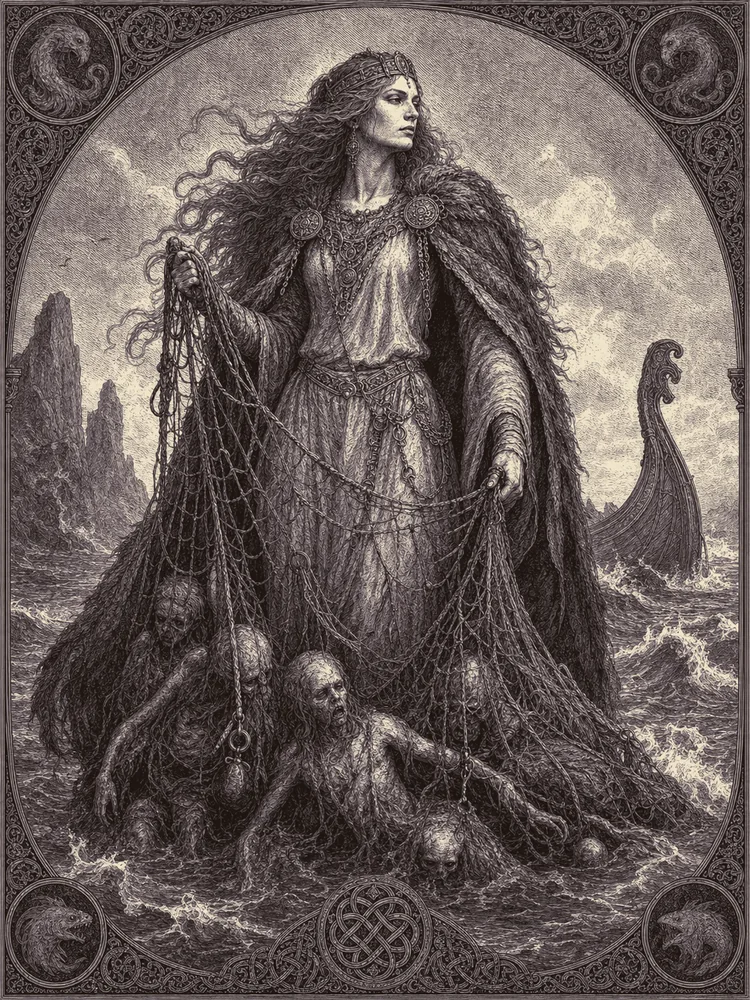
Ran was the wife of Aegir, mother of his nine daughters the waves. She was the goddess of those who drowned; she had a great net (its name was, naturally, Ránet, "Ran's net") with which she caught seafarers and drew them down to her hall beneath the waves, where she received them as her guests. To die at sea was to go to Ran rather than to Hel, and the Norse held it lucky for a drowning man to have a piece of gold to offer her at his arrival, that he might not come empty-handed; gold was sometimes called "Ran's fire" for its association with her hall.
 Before thisAegir
 Next on the wallFenrir
Curator’s note
What the sources say, and what later tradition added. The sources for this bay
Skáldskaparmál 25, 33; Helgakviða Hjörvarðssonar 18 (the gold-and-Ran association). The custom of carrying gold against drowning is mentioned by Snorri and is plausibly historical.
Kin in the sources
Each tie is quoted from the entry that states it.
- Consort ofAegir
Ran was the wife of Aegir, mother of his nine daughters the waves.
 Compared withHel
To die at sea was to go to Ran rather than to Hel
When the sources speak
Dated witnesses for The Norse and Germanic Gods. A date marks when the evidence was written down, not when the belief began. The whole timeline
- 2nd–1st millennia BCE
- Indo-European language dispersals and regional Bronze Age cultures provide a remote comparative background, not a recoverable common canon.
- c. 500 BCE–1 CE
- Iron Age material culture, names, sanctuaries, and classical ethnography offer early but external evidence for Celtic and Germanic religions.
- 1st–4th centuries CE
- Roman inscriptions and provincial cults preserve many Celtic, Germanic, and local divine names.
- 4th–8th centuries CE
- Migration-period and early medieval conversion transform ritual institutions while heroic traditions continue.
- 8th–11th centuries CE
- Viking Age poetry, runic evidence, archaeology, and Scandinavian conversion form the core context of Norse myth.
- 9th–12th centuries CE
- Slavic, Baltic, and Finnic traditions enter chronicles and missionary accounts, often through hostile observers.
- 11th–14th centuries CE
- Irish, Welsh, and Icelandic manuscripts preserve major narrative corpora in Christian literary environments.
- 12th–16th centuries CE
- Saxo, saga compilers, Baltic chroniclers, and later antiquarians systematize or reinterpret older material.