A Compendium of the Ancient Gods
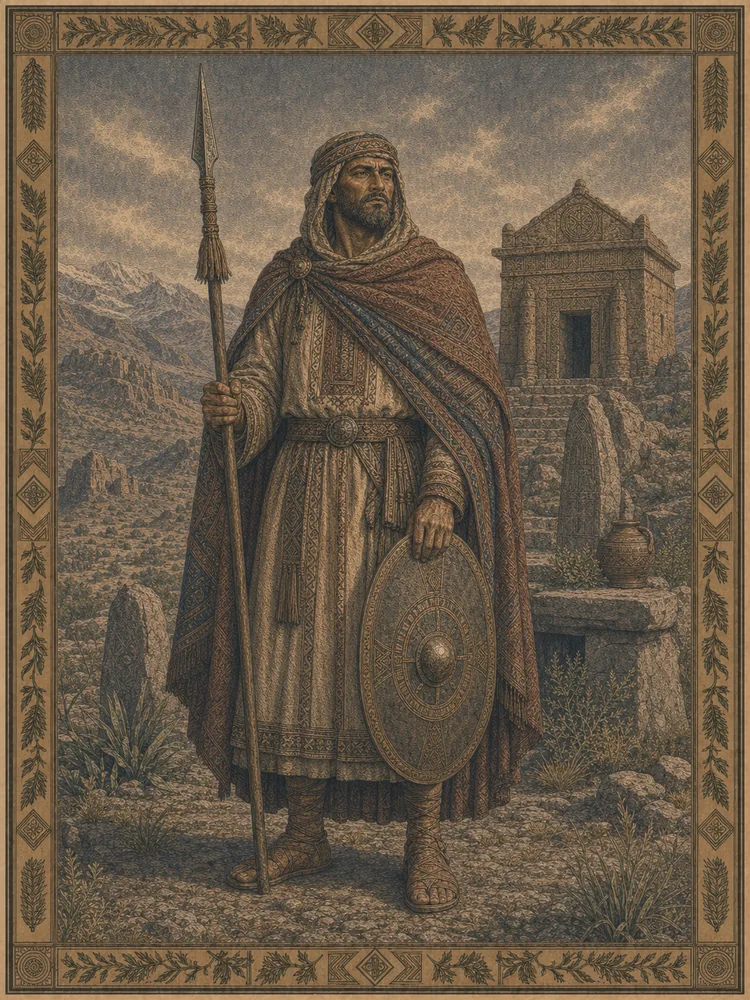
Aulisua, plate

Aulisua was a Mauretanian local deity, attested chiefly through Latin inscriptions of the Roman provincial period from the territory of modern Morocco and western Algeria. The dedications to Aulisua are preserved at a small number of sites; he was identified by the Romans variously with Mars (in his warrior aspect) and with Iuppiter (in his sovereign aspect), reflecting the breadth of his functions and the difficulty Roman administrators had in finding a Mediterranean equivalent.

The figure is, like Bonchor (in the previous entry), one of the many local Berber deities of Roman North Africa whose cult was preserved under provincial administration but whose deeper religious content was rooted in the indigenous Berber-Mauretanian tradition. The Mauretanian kingdom (which had been independent under King Juba II in the Augustan period and was annexed as Roman provinces — Mauretania Tingitana and Mauretania Caesariensis — in 42 of our era under Claudius) preserved its indigenous pantheon in fragmentary form through the Roman period, and Aulisua is one of the better-attested of these local deities.

His cult-image, where it is depicted in surviving reliefs, follows the standard provincial warrior-deity pattern (helmet, spear, shield), which is consistent with the Mars-identification but probably represents a Romanizing overlay on an indigenous figure whose original iconography was distinct. The Berber preference for aniconic representation (mentioned under Anzar above) was probably the indigenous norm for Aulisua, with the Roman-style figural representation being a provincial-period development.

After the Christianization of North Africa, Aulisua's cult disappeared. The figure preserves, like Bonchor, a name and a fragmentary record of an indigenous Berber religious tradition that flourished alongside the Roman provincial system but that was largely extinguished by the religious transformations of late antiquity.

Curator’s note

What the sources say, and what later tradition added. The sources for this bay

Aulisua is documented in Latin inscriptions from Mauretania; the standard collection is the CIL VIII volumes and the Inscriptions Antiques du Maroc. The standard treatment is in Gabriel Camps's works and in the volumes of the Encyclopédie berbère. The wider context of Berber-Mauretanian religion is in the works of David Mattingly (Tripolitania, 1995) and in the late-ancient North African historical surveys.

Kin in the sources

Each tie is quoted from the entry that states it.

When the sources speak

Dated witnesses for The Berber Amazigh Pantheon. A date marks when the evidence was written down, not when the belief began. The whole timeline

2nd–1st millennia BCE
Bronze and Iron Age regional cultures establish the archaeological backgrounds later labeled Thracian, Illyrian, Iberian, Caucasian, and Libyan.
8th–6th centuries BCE
Greek and Phoenician colonization creates new inscriptional, artistic, and commercial contact zones.
6th–4th centuries BCE
Classical authors begin describing frontier peoples and translating local gods into Greek categories.
3rd–1st centuries BCE
Hellenistic kingdoms, Carthage, and Rome intensify political and cultic exchange.
1st century BCE–3rd century CE
Roman provincial rule produces dedications, coins, reliefs, and interpretive equations across the Balkans, Iberia, Caucasus, and North Africa.
4th–7th centuries CE
Christianization and imperial change end or transform many public cult institutions while names persist in texts and places.
medieval period
Georgian chronicles and epic traditions, Iberian memory, and North African historical sources reshape pre-Christian inheritances.
2nd–1st millennia BCE
Libyan groups appear in Egyptian records and regional archaeology.

Floor plan

The rooms follow one another in the order their peoples first appear in the written record.

  1. The Cradle of Citiesc. 3400 BCE to 395 CE. 115 works
  2. The Gift of the Nilec. 4000 BCE to 395 CE. 73 works
  3. The Olympian Orderc. 1600 BCE to 750 CE. 152 works
  4. The Persian Worldc. 2000 BCE to 1010 CE. 30 works
  5. The Levantine Borderlandsc. 1200 BCE to 500 CE. 20 works
  6. The Edges of Empirec. 2000 BCE to 1500 CE. 33 works
  7. The Etruscan Worldc. 900 BCE to 750 CE. 22 works
  8. The Roman Inheritancec. 1200 BCE to 500 CE. 58 works
  9. The Northern Inheritancec. 2000 BCE to 1600 CE. 131 works