A Compendium of the Ancient Gods
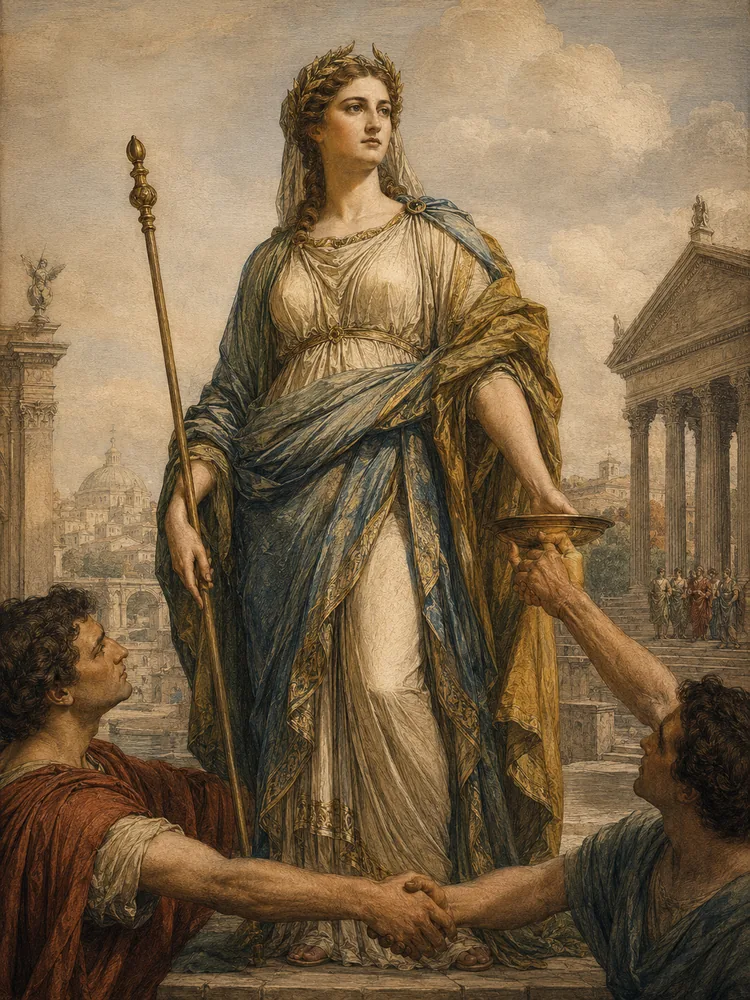
Concordia, plate

Concordia was the deified principle of harmony among the citizens of the state — the goddess whose presence meant the absence of civil discord, whose departure meant the strife that the Romans, after the experience of their long civil wars, had learned to dread above all other political conditions. Her cult was anciently established. Her great temple in the Forum, at the foot of the Capitoline hill, was traditionally founded by the dictator Camillus in 367 BCE to commemorate the reconciliation of the patricians and plebeians (after the long social struggle that had at last produced the Licinian-Sextian rogations admitting plebeians to the consulship); the temple was rebuilt several times, most magnificently by Tiberius in 7 CE (the so-called Temple of Concordia Augusta), and it was one of the most architecturally distinguished buildings of the imperial Forum.

Concordia received state sacrifices on January 16 (the dedication-day of Tiberius's reconstruction), at moments of political reconciliation, and at the conclusion of foreign wars. Her image appeared on coinage of nearly every emperor; the legend Concordia Augusta was a standard imperial slogan, indicating the harmony of the imperial family or of the state. She was depicted as a matron holding a patera (the offering-bowl) and a cornucopia, sometimes also an olive branch, occasionally accompanied by Pax (Peace, her near-relation). Her Greek counterpart was Homonoia, who had been honored with a similar (though less elaborately developed) cult in the Hellenistic cities; the Roman Concordia owed something to this Hellenistic example but went considerably beyond it in cultic elaboration.
Curator’s note

What the sources say, and what later tradition added. The sources for this bay

The principal sources are Ovid, Fasti 1.637–650 (the Tiberian dedication); Plutarch, Camillus 42 (the original 367 BCE foundation, though some modern scholars doubt the early date and place the original temple later); Cassius Dio 55.8 (Tiberius's reconstruction); the abundant numismatic record. The temple's foundations are still visible in the Forum, near the foot of the Capitol. The relationship of Concordia to Homonoia is treated by G. Skard, Concordia in lateinischer und griechischer Literatur (1932).

Kin in the sources

Each tie is quoted from the entry that states it.

When the sources speak

Dated witnesses for The Deified Virtues and the Imperial Mystery Cults. A date marks when the evidence was written down, not when the belief began. The whole timeline

c. 1000–750 BCE
Iron Age communities of Latium and neighboring peoples develop the cult landscapes later absorbed into Roman tradition.
traditional 753 BCE
Roman foundation chronology places Romulus and the first civic institutions at the beginning of the city’s sacred history.
traditional 7th–6th centuries BCE
The regal period is credited with priesthoods, calendars, temples, and the organization of public rites.
509–264 BCE
Republican expansion incorporates Latin, Sabine, Etruscan, and Italian cults through treaty, migration, and evocatio.
264–146 BCE
Mediterranean conquest accelerates Greek interpretation and the importation or redefinition of foreign gods.
204 BCE
The Magna Mater is formally brought from Pessinus during the Second Punic War.
1st century BCE
Varro, Cicero, and other antiquarians document rites and divine names amid civil war and institutional change.
27 BCE–14 CE
Augustan restoration monumentalizes selected ancestral cults and rewrites Roman sacred history.

Floor plan

The rooms follow one another in the order their peoples first appear in the written record.

  1. The Cradle of Citiesc. 3400 BCE to 395 CE. 115 works
  2. The Gift of the Nilec. 4000 BCE to 395 CE. 73 works
  3. The Olympian Orderc. 1600 BCE to 750 CE. 152 works
  4. The Persian Worldc. 2000 BCE to 1010 CE. 30 works
  5. The Levantine Borderlandsc. 1200 BCE to 500 CE. 20 works
  6. The Edges of Empirec. 2000 BCE to 1500 CE. 33 works
  7. The Etruscan Worldc. 900 BCE to 750 CE. 22 works
  8. The Roman Inheritancec. 1200 BCE to 500 CE. 58 works
  9. The Northern Inheritancec. 2000 BCE to 1600 CE. 131 works