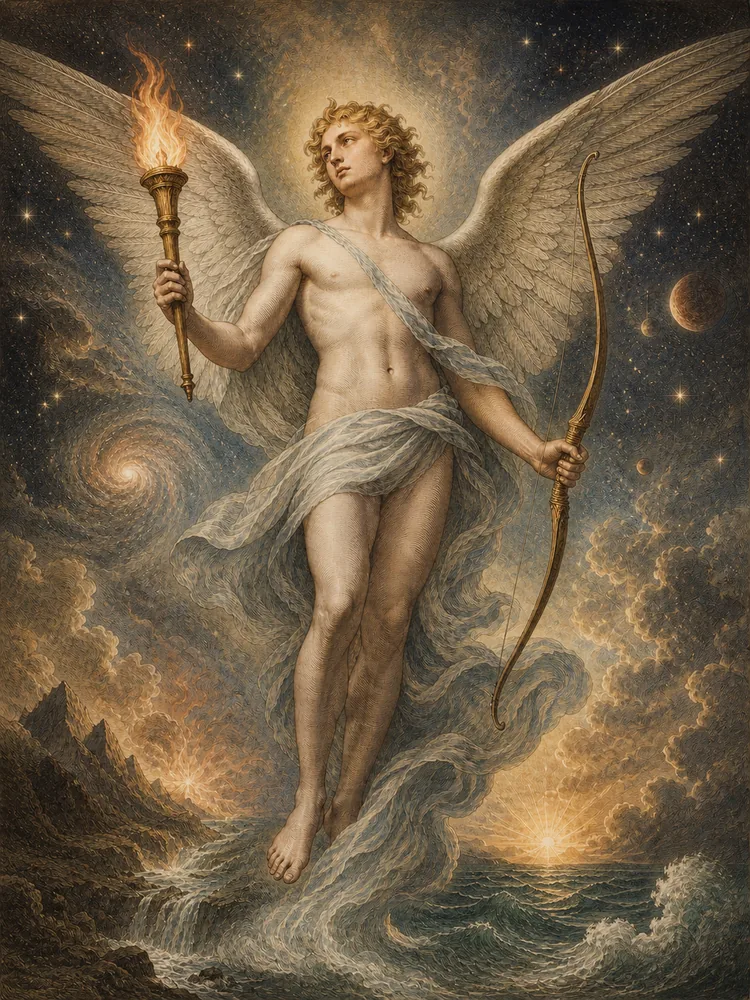
Eros, in Hesiod's primordial sense, was the great cosmogonic power that drew the elements together so that they might generate. He came forth from Chaos at the beginning along with Gaia and Tartarus, and was "the most beautiful of the deathless gods, who loosens the limbs of all gods and all men, and overcomes their good counsel and their wise mind in their breasts." He was not the boy with bow and arrow that the later mythology made him (a younger Eros, son of Aphrodite, treated in his own entry below); he was the primordial unifying force, without which no generation could occur. The Orphic cosmogony made even more of him: in the Orphic theogonies, Eros (or his Orphic counterpart Phanes) was the first-born of the cosmic egg, the bisexual original light from whom all the gods proceeded. The Pre-Socratic philosophers, particularly Empedocles, made Love (Philotes) and Strife (Neikos) the two cosmic principles by whose alternation the world was repeatedly composed and dissolved.
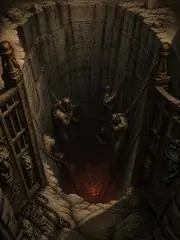 Before thisTartarus
 Next on the wallAether
Curator’s note
What the sources say, and what later tradition added. The sources for this bay
Hesiod, Theogony 120–122, gives the primordial Eros; the Orphic treatments are preserved in fragments quoted by later authors (especially Damascius and the Derveni Papyrus, the latter discovered in 1962 and providing rare direct evidence for fifth-century Orphic cosmogony). Empedocles, Fragments DK 17–22, makes Love and Strife the cosmic principles. The distinction between the primordial cosmogonic Eros of Hesiod and Orpheus and the later mythological Eros (the boy with bow, son of Aphrodite, who shoots gods and mortals into love-affairs) was already a literary commonplace by the time of Plato (Symposium 178b), where the speakers debate which Eros they mean.
Kin in the sources
Each tie is quoted from the entry that states it.
 Child ofChaos
He came forth from Chaos at the beginning along with Gaia and Tartarus
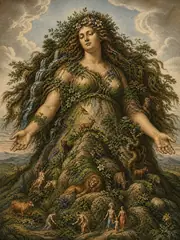 Sibling ofGaia
He came forth from Chaos at the beginning along with Gaia and Tartarus
- Sibling ofTartarus
He came forth from Chaos at the beginning along with Gaia and Tartarus
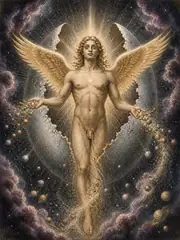 Named as the same god asPhanes
Eros (or his Orphic counterpart Phanes) was the first-born of the cosmic egg
When the sources speak
Dated witnesses for The Primordial Powers. A date marks when the evidence was written down, not when the belief began. The whole timeline
- c. 1600–1100 BCE
- Mycenaean palace tablets in Linear B record offerings and divine names, but little continuous myth.
- c. 1100–800 BCE
- Post-palatial oral traditions and changing cult landscapes precede the surviving alphabetic epics.
- late 8th–7th centuries BCE
- The Iliad, Odyssey, Hesiodic Theogony and Works and Days give influential but non-exclusive divine orders.
- 7th–6th centuries BCE
- Homeric Hymns, lyric poetry, colonization, and local sanctuary traditions multiply regional narratives.
- 6th–5th centuries BCE
- Orphic, Pythagorean, and mystery materials develop alternative cosmogonies and afterlife doctrines.
- 5th century BCE
- Athenian tragedy and comedy recast heroic houses and divine justice for civic audiences.
- 4th century BCE
- Philosophers, antiquarians, and local historians interpret or criticize inherited myth.
- 323–31 BCE
- Hellenistic poets and scholars systematize variants across an enlarged Greek world.